Showing posts with label Amazon Conservation. Show all posts

Tuesday, July 19, 2011

Apetina Schoolchildren Take Part in Primary Exams: Building the Future of Indigenous Children

Editor’s Note: In her role as communications and information coordinator for the Amazon Conservation Team Suriname, Karin Lachmising works with ACT’s indigenous colleagues to capture their stories and share the great work being done in Suriname’s remote indigenous villages.

This month, for the first time, seventeen children from the indigenous village of Apetina in southwest Suriname will participate in the primary school exams. I sat down with the man who made this all possible, headmaster Arnold Arupa, who came to Apetina six years ago to act as headmaster of the first primary school in the village. 

In early days, the missionaries held classes in reading and calculating, lessons that were given in the Wayana language. When Arnold started with a group of the best children in the first grade, his mission was to prepare them to finish the primary school curriculum. It was his goal to prepare them for the exams and he guided them for five years thoroughly. 

Although Dutch is the official language, the children found it easier to learn when the official school started as they already had done some basics in their own indigenous Wayana language. This made it easier for them to understand the different subjects such as calculating, spelling and grammar. The hardest subjects for the children were geography and history. Headmaster Arupa had to use all his creativity to bring the information closer to the children and to make them like it.

“It is not easy, when you’ve never been out of the village, to learn about things like the Caribbean, the islands, trucks, ships and roads,” shares headmaster Arupa. “But I am confident that this group is ready for their exams.”

When they finished the first grade, Arnold asked the Ministry of Education for permission to allow the best 20 children to skip a class, because they had done very well, and he guided them as the “exam team.”  The children on the team range in age from 12 to 19 years old.

“Now they are ready for it,” he says. “And I am very proud. Almost the whole group is still together; only three children left the group of 20.”

We have a beautiful building now with four teachers from town and one local teacher. I think these children can set an example that it is really possible to succeed at school. I asked Arnold: What they will do after they have succeeded?

“This is a difficult step for all of the children in the interior of Suriname,” Arnold responds. “For further education they have to go to town, there is no other possibility. Sometimes family takes them in, but most of them have to stay in boarding school, which is for most families not financially or socially manageable.”

For now, Arnold concentrates on the exams, the first step to the children’s futures. When the children were asked what they want to become in the future, they answered with a wide range of jobs, but all have a link with their own environment: a pilot, a nurse and most of them, a teacher. One of the children, when asked a few times, said with some hesitation but with an inner confident spirit that he wanted to be a doctor. 

“The grades so far have been the best of the interior,” says Arnold proudly. “So I am quite confident they have a good chance.”

It seems headmaster Arnold is even more nervous than the children.

“I know,” he says, with a big smile. “But I really want them all to succeed.  I’ve worked such a long time with these kids and I admire them for the effort they and their families at home took to keep on coming to school and learn in an environment which is so very different from what you learn in your schoolbooks.”

Karin Lachmising
Amazon Conservation Team, Suriname
Communication & Information Coordinator

Monday, December 13, 2010

Surui Tribe Launches Carbon Fund

As I return from the United Nations Climate Conference (COP16), I'm happy to share that there is some good news coming out of Cancún despite all the media headlines of stalled conversations. ACT is working on very concrete projects that will have a direct impact on the implementation of policies regarding the reduction of carbon emissions in the rainforests of South America.

ACT has taken the lead in creating coalitions of NGOs and indigenous peoples to design and implement effective land management solutions, and now is working with its partners to ensure that these solutions can be applied broadly - both on the ground, and also to positively impact the policy negotiations and implementation of Reducing Emissions from Deforestation and Forest Degradation (REDD) and REDD+. ACT is an integral part of the discussions surrounding the design of these methods where the results generated on the ground will help to shape how these solutions can potentially be implemented on an international scale.

I joined Chief Almir of the Surui Tribe in Brazil at COP16 in his announcement of the launch of the Surui Carbon Fund. The Fund-created by the Surui with help from the Brazilian Biodiversity Fund (FUNBIO)-will enable the indigenous community to manage the funds derived from the marketing of their carbon credits. The Surui will be responsible for fund financial management as well as implementation of their self-created management plan for their 600,000-acre reserve in Rondônia, Brazil.


The Surui Carbon Project is an initiative led by the Surui and involves expert NGOs including Kanindé, Forest Trends, FUNBIO, and the Institute for Conservation and Sustainable Development in the Amazon. The project uses two forms of carbon offset: avoided deforestation and conservation through carbon stocks, as measured through the REDD mechanism; and carbon sequestration through reforestation. The impact of the project will go far beyond the Surui and will bring new alternatives in the management of indigenous lands to other indigenous groups worldwide. 

Vasco van Roosmalen
Director, Amazon Conservation Team Brazil

Monday, October 11, 2010

Inga Education: An Innovative Model Enjoys National Recognition

Through our work at ACT, we see education as a pillar, a powerful tool for change. We usually take for granted education as instruction that one receives within four walls, but for indigenous groups, education is much broader than that, contrasting with western ways of acquiring knowledge.

In Colombia, western education systems have been one of the most aggressive means of acculturation among indigenous groups, in many cases making communities abandon their traditional rituals, dress and language. Nevertheless, Colombian constitutional rights since 1991 and the national compliance with Convention 169 of the International Labor Organization have allowed indigenous communities to develop an educational model that responds to their particular needs, values, and traditions as well as their social, economic and cultural desires.

It has taken many years for national legislation and policies to become effective and for indigenous communities to create their own institutions as well as the means to develop a curriculum appropriate for the Colombian intercultural context.

In this regard, we have some great news to share! Recently, the Colombian government approved the national contracting (funding) of the Yachaicury Ethno-Education School of the Inga indigenous community of the department of Caquetá to continue providing education that meets both national quality standards and indigenous traditional ways of learning. To this development, I wish to say
hallelujah! This certification is of immense importance for the recognition of indigenous rights in our country.

Because of the absence of suitable education for their youth, the Inga community of the Caquetá has developed a curriculum structured to provide coursework embracing traditional knowledge such as traditional medicine and forest stewardship, in addition to standard “western” subject matter. The Inga community has determined that new generations must be educated under the guidance of their traditional authorities, many of whom carry expert knowledge of the surrounding forests and their diversity.

At the School, approximately 80 Inga students, 5 to 18 years old, participate in training courses emphasizing sustainable agriculture, and record ancestral knowledge in their native language. Located on 136 acres, the school grounds include a natural sciences laboratory and an agro-ecological farm where the students learn firsthand the sustainable farming techniques that allow them to grow their own food, contribute to the food resources of the surrounding communities, and provide an economic base for their institution.

The Yachaicury School is the first Inga school in Colombia and the first indigenous school in the Caquetá department to receive this very important political recognition. I’ve included a video clip which highlights some of the School’s educational aspects.


Javier Ortiz Bahamón
Colombia Program Director
Amazon Conservation Team

Thursday, September 30, 2010

Biodiversity and Health

The United Nations declared 2010 the "International Year of Biodiversity." We naturally are very gratified that this subject has been given such prominence, since the conservation of rainforest biodiversity has been a primary goal of the Amazon Conservation Team since our founding 15 years ago.

One of the most unique, creative, and passionate experts on the subject of biodiversity is physician Christopher Herndon, a longtime friend and ACT colleague. Chris received his medical training at Yale and Harvard and from the shamans of the northern Amazon the latter he is quick to cite as particularly formative to his development as a physician and his understanding of healing.

Chris recently teamed up with another leading spokesman for conservation – journalist Rhett Butler, who publishes the extraordinary website www.mongabay.com – to pen a commentary for the influential journal Biotropica. Read the full article here. I think you will find it both insightful and informative.

Mark J. Plotkin, Ph.D.  
President, Amazon Conservation Team

Thursday, September 16, 2010

Colombia Women's Programs

Editor’s Note: As Vice President of Programs, Liliana assists ACT’s in-country colleagues. As part of that role, she helps cultivate women’s programs that build esteem and advance human rights among women across Amazonia. In this post, Liliana describes her experience at a recent women’s gathering organized by the Union of Women Healers (ASOMI) of the eastern Andean Amazon.

My trips to Colombia are generally very short, never enough time to really visit projects, sit for unscheduled chats over “tintos” (small cups of freshly brewed Colombian coffee), that can go several hours. This summer, determined to share a bit of my work with my daughter Annie, and our friends Stephanie and Hannah Dodson, we set out to the Valle de Sibundoy – a lovely highland region where ACT has projects. We focused on the work of ASOMI – a group of indigenous women – all either shamans, healers or simply really wise old ladies, who are struggling to strengthen their families, communities, and traditional medicine. A small component includes their “chagras” – small gardens where they grow their medicine and nourishment. Nothing is more important to them since they derive so much for their overall physical, emotional, and spiritual health. ACT’s support helps them with the very basics so they can continue to keep that which means so much. I don’t think there is a need for a translation of mama Carmencita explaining why the chagra is so important – is her joy contagious or what?
- Liliana Madrigal
Amazon Conservation Team
VP of Programs

Friday, September 10, 2010

Amazon Rainforest: "The World's Heart"

Editor's Note: Dr. Sara Bennett is a biologist who leads a small NGO, Maikuchiga, in Colombia’s Amacayacu National Park that operates a rescue center for orphaned animals. The Park, in the nation’s Amazonas state, is traversed by the Amazon River. This post is one in a series from Dr. Bennett. Post originally developed May 5, 2010.

After the epic battle with the bees, the toucans seem not to be nesting this year.

It’s always trickier perceptually to notice an absence than a presence, something NOT happening that’s part of one’s peripheral normalness. I finally twigged on this, and after registering my own observation and confirming it with the guys, then noticing that I’m disappointed, began to wonder in background mode, How come?

On the front porch, holding Rosie, the long-tailed, adolescent spider monkey (who is really a little too big for this but didn’t have enough hugs earlier in her life so we’re doing some catch-up), a nice soft, wiggly solidness centering the universe for a moment in my arms, I was aware as well of all the colors of the early morning forest around us.

It’s usually hard to see the trees because of the forest here, but lots of species have new leaves right now and for a few days each one is distinct in hue and overall effect (it’s lovely, thank you world, nicely done). Then I suddenly get what’s going on with the toucans. This year it’s about new leaves, not fruit.

Friday, September 3, 2010

Traditional Diahui Festival

Traditional Diahui Festival
Like the Kaxuyana of northern Brazil and the communities of the Middle Rio Negro region, the Diahui people of the western Brazilian Amazon built a central maloca (roundhouse) for the first time in many decades. ACT, the Brazilian NGO Kanindé, the Instituto Internacional de Educação do Brasil, and USAID supported the construction of the maloca as well as the first traditional festival that the Diahui have held in almost half a century, taking place in the third week of August. They danced, sang and played their flutes for two days straight. All food and dress was traditional. It was quite an experience being part of this ceremony.

Until the mid-1990's, just a few Diahui remained and lived spread out in other tribal villages or even the city. Thanks to the leadership of one Diahui, they were able to reconstitute their community and gain territorial recognition. Today, there are approximately 70 Diahui who live in one village on their traditional lands.

New Central Maloca
The Trans-Amazon Highway (Porto Velho-Santarem-Belem) passes straight through their village, and they have set up a toll booth to collect fees from passing trucks and cars to compensate the community for the road and its impacts. The impact of the road and access to the outside world has in many ways been disastrous, but these people really have pulled back from the brink. Today, they have a functioning association, which is receiving independent funding as well as support from Kanindé and the Moore Foundation, and they are implementing a diagnostic survey implemented jointly by Kanindé and ACT, a cultural mapping project (idem), a vigilance plan and park guard training all funded by USAID.  The Diahui also wish to commence a REDD carbon project in the near future.

I have included a photo that was taken off a bridge from the Trans-Amazon Highway on the way to the Diahui lands. This photograph is of a member of the Piraha tribe, which is still nomadic, speaks almost no Portuguese and who live close to the road and the Diahui. This tribe was almost wiped out by missionaries and has fought to retain their culture and nomadic lifestyle.

Vasco van Roosmalen
ACT Brazil Program Director

Wednesday, September 1, 2010

Belo Monte Dam Complex

Since 1999, ACT has supported the tribes of Brazil’s 6.5-million acre Xingu Indigenous Reserve in their efforts to formulate land management plans and to acquire the necessary technical and administrative skills to assume full responsibility for their conservation and sustainable development activities. Recently, international attention has been drawn to the region due to the likely highly negative impacts of the proposed Belo Monte Dam Complex on the Xingu’s people and ecology. To understand why this matter is of such great urgency, watch the new Google Earth tour and YouTube video “Defending the Rivers of the Amazon” by Amazon Watch and International Rivers.

Wednesday, August 18, 2010

Picturing the Brazil Forest Fires

Editor's Note: Yesterday we shared a post from Frederico Schlottfeldt on the Brazil forest fires in our Brazil office. Today we share a direct encounter of the fires from our Brazil Director. In mid-August 2010, ACT-Brazil Director Vasco van Roosmalen traveled via the BR-364 road in the Brazilian state of Rondônia between the population centers of Cacoal and Porto Velho. The area represents one of the great remaining Amazonian frontier regions, and is susceptible to forest fires, many created intentionally to clear land.  

Vasco documented the air effects of these fires:

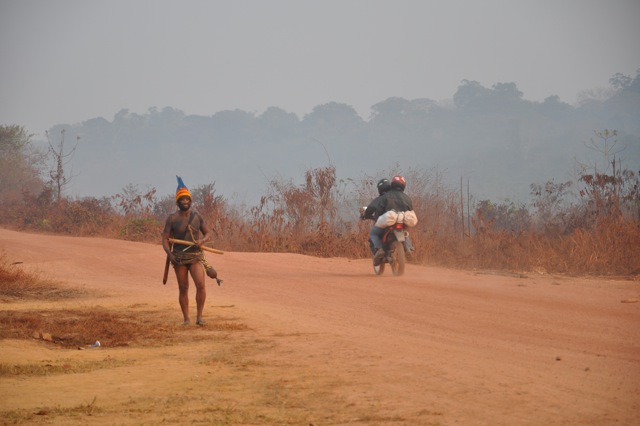
“It is hard to capture in a photo just how much smoke from forest fires is covering the area. It has been really bad for almost a week now. These pictures were taken on the outskirts of Cacoal, where Metareila, the association of the indigenous Surui people is located.

We are in the middle of the Amazon, where there just isn't enough industry and there are not enough cars to create smog like this over such a large area. The sky in these pictures should be full blue...there is not a cloud in the sky.”


Vasco van Roosmalen
ACT Brazil Director

Friday, August 13, 2010

Environmental Education

Editor's Note: Dr. Sara Bennett is a biologist who leads a small NGO, Maikuchiga, in Colombia’s Amacayacu National Park that operates a rescue center for orphaned animals.  The Park, in the nation’s Amazonas state, is traversed by the Amazon River. This post is one in a series from Dr. Bennett. Post originally developed February 6, 2010.

Saturday morning, Animals House. Claudia, the littlest, special-needs woolly monkey, is a nice warm, fast asleep, softly snoring, getting better lump on my lap. It’s raining quietly outside, with no drama.  The river’s rising.
Dr. Sara Bennett with manatee
There is no crisis at the moment and no one’s being bad (Aladino having just fixed the hole one of the squirrel monkeys either made or found to get into the kitchen and make a big mess).  A faraway hoodoo pigeon is calling “hoo doo, hoo doo.”  Lo, the spirit moves.
A friend from Palmeras, the community just upriver, told us last week that there was a woolly monkey in Eugenio’s house that was probably the aforementioned Surba. Jhon and I went up to check it out. It checked out and we’re concerned again.  They’d come across her in the woods about a two hour walk away, and either she came back with them or they brought her back and was with them a few days in their house. They left the house alone on Sunday and she was gone when they came back. The upriver communities think woolly monkeys are delicious and fair game. The four downriver communities think woolly monkeys are delicious and have agreed not to hunt them. We have spread the word that if someone helps us round her up (alive), the reward will be better than one monkey stew.
So, ahem, Topic for the Day here: environmental education in acculturated indigenous communities.  Whatever does this mean and how do you do whatever it is? Without being Right, culturally insensitive, overbearing, arrogant, well-meaning, out-of-context, irrelevant, disrespectful  …  There are a lot of reasons to let this be someone else’s responsibility.  Someone Else hasn’t shown up.

Tuesday, June 15, 2010

We Want our Planet Back.

New Orleans is the most aquatic of American cities.

This may seem surprising, in light of the fact that other cities exist atop islands, making them a more likely candidate for this title, but a number of factors bear consideration.

Sited as it is in a crescent-shaped bend in the Mississippi River, New Orleans is surrounded by river to the west, south, and east. And, to the north is Lake Ponchartrain, the second largest saltwater lake in the United States.

And what makes the city so thoroughly aquatic is the water underneath. When I was growing up in New Orleans, I was taught that we lived at sea level. Post-Katrina, we all know that such is not the case – the Crescent City, to a large degree, is below sea level. With the exception of some relatively high ground areas like the French Quarter, St. Charles Avenue and the Esplanade ridge, much of New Orleans is a below sea-level bowl into which water poured after that horrible hurricane.

Perhaps the two most unique aspects of New Orleans’ culture and history are intimately linked to this aquatic setting. Ask anyone who has been to New Orleans what makes the city so unique, and the two most common answers are almost always the same— food and music. And the food comes from the water around us: crabs, crawfish, oysters, shrimp, seafood gumbo and jambalaya, frogs legs and turtle soup. New Orleanians have a sensual – almost erotic - fixation with their food. Just ask an ex-pat New Orleanian planning on a visit to his or her hometown where and what they will be eating, and you will receive a detailed response more akin to planning the D-Day invasion of Normandy than a simple trip home.

And New Orleanians treasure most highly the foods from the waters that surround them. New Orleanians feast on foods from the waters.

From the classical compositions of Louis Gottschalk to the rhythm and blues piano of Professor Longhair to the rap stylings of Lil’ Wayne, New Orleans has produced more than its share of music and musicians. But the most important musical genre born in the Crescent City is jazz. While many different cultures contributed to the birth of jazz, most credit the combination of African, Caribbean, and European sounds as having the greatest influence. And all of these influences met and mixed because New Orleans was such an important port of entry into the United States.

But the Gulf through which New Orleans has derived so much sustenance – both edible and cultural – still fills with poison. In the wonderful 1999 film “Three Kings,” the American soldier played by Mark Wahlberg is captured by Saddam’s soldiers. They tie him up, say he and the Americans can have all the oil they want, and they force him to drink it – a sad, frightening, and somewhat appropriate analogy to the situation we have witnessed on the nightly news for 57 days.

Breaking our addiction to foreign oil has been a much bandied-about goal since the Carter Presidency. After 9/11, journalist Tom Friedman called for a dollar a gallon tax on gasoline to reduce demand and provide generous funding for research on alternative energy sources. None of these propitious cries were heeded.

BP’s CEO recently whined that he “wants his life back.” Well, Tony – we want our Gulf back.  We want our economy, culture, seafood, and our wetlands back.  We want our history and our way of life back. We want our planet back.

We are all somewhat complicit in this disaster—all of us who use fossil fuels, all of us who waste fossil fuels. But now we all see more of the real costs: injured wildlife, human suffering, and cultural degradation that happens when we do not treasure Mother Nature and her gifts.  Giving giant companies a free hand—free from regulation, free from oversight—does not mean there is a free ride.  Eventually, the bill comes due—and we all end up paying it.

Mark J. Plotkin, Ph.D.

Wednesday, March 3, 2010

ACT's Present Position on Climate Change

ACT believes, on the basis of very strong evidence, that accelerating global climate change is a reality, and that this acceleration is caused by human activities, specifically the injection of greenhouse gases into the atmosphere.

Though it is not possible to predict the exact consequences of the overall warming trend that this increase in the greenhouse effect creates, ACT also believes that it is sensible to expect that some local changes may have very negative effects on vulnerable populations, both human and otherwise.

Indeed, it is already obvious that many areas—notably the temperate zones where humans live—are becoming drier, putting increased pressure on already scant water resources. Over time, the more our planet warms, the fewer winners and the more losers there will be. Therefore, both mitigation and adaptation strategies are needed.


Read more about ACT and mitigating climate change.

Thursday, December 17, 2009

Striking a deal in Copenhagen


As the conference winds down, the countries of the world are scrambling to strike a deal.

The developing nations claim – correctly – that the industrialized nations have generated most of the pollution believed to be causing climate change. These developing countries believe the industrialized world should provide massive funding to mitigate or halt climate change.

The industrialized world claims – correctly – that enormous transfer of wealth guarantee nothing without better safeguards that monies will be spent efficiently and effectively.

Further complicating this dilemma is the fact that some large developing countries are extremely wealthy and are generating enormous amounts of pollutants themselves.

These are major sticking points, but there are many other challenges and nuances. For example, what is the role of indigenous peoples? If an enormous fund is established to protect the rainforests, does a piece of the action go to the Indians, or does all the money go to national government (or state governments? Or NGOS? etc. etc.) Can indigenous people negotiate conservation accords on their own (so-called “subnational rights”) or does everything have to go through national governments?


And what is the role of monitoring? Several governments, still smarting from a legacy of colonialism, loathe the concept of industrialized nations checking to see whether these developing nations are keeping their promises in terms of protecting forests or emitting pollutants. Industrialized nations argue that accepting major funding to modify carbon output or carbon capture means that you must agree to be monitored. The discussion continues…

Some of the best news of the conference comes from the technological world: we can remotely monitor down to the level of a single tree in many forests of the world. Yet agreements need to be reached on the role of monitoring if this technology is to prove as useful as it can be. And enhanced forest monitoring without enhanced forest protection would ultimately prove futile.


-Mark J. Plotkin, Ph.D.

Wednesday, December 2, 2009

Ethnographic maps built using cutting-edge technology may help Amazon tribes win forest carbon payments

The following is adapted from November 29th article by Rhett A. Butler of Mongabay.com.


A new handbook lays out the methodology for cultural mapping, providing indigenous groups with a powerful tool for defending their land and culture, while enabling them to benefit from some 21st century advancements. Cultural mapping may also facilitate indigenous efforts to win recognition and compensation under a proposed scheme to mitigate climate change through forest conservation. The scheme—known as REDD for reducing emissions from deforestation and degradation—will be a central topic of discussion at next month's climate talks in Copenhagen, but concerns remain that it could fail to deliver benefits to forest dwellers.

Much of the Amazon rainforest remains occupied by tribal groups. While few of these live as conjured in the imagination, the state of the forests in their territories is a testament to their approach to managing lands. But like the Amazon itself, these groups face new pressures from the outside world. For the indigenous, the lure of urban culture is strong—cities seem to offer the promise of affluence and the conveniences of an easy life. But in leaving their forest homes indigenous peoples are usually met with a stark reality: the skills that serve them so well in the forest don’t translate well to an urban setting. The odds are stacked against them; they arrive near the bottom of the social ladder, often not proficient in the language and customs of city dwellers. The lucky ones may find work in factories or as day laborers and security guards, but many eventually return to the countryside. Some re-integrate into their villages, others return in a completely different capacity than when they departed. They may join the ranks of miners and loggers who trespass on indigenous lands, ferreting out deals that pit members of the same tribe against each other in order to exploit the resources they steward. As tribes are fragmented, and forests fall, indigenous culture—and the profound knowledge contained within—is lost. The world is left a poorer place, culturally and biologically.

But there is new hope, embodied by efforts to enable tribes to become more self reliant through the use of state-of-the-art technology that builds on and leverages their traditional knowledge. These tools can help them better defend their lands and offer the potential for the next generation of Surui, Trio, or Ikpeng to have a future of their determination rather than one dictated to them by a society that values the resources locked in their territories over their forest knowledge and rich cultural history. Through such technology, tribes may be able to avoid a fate in which they become destroyers, rather than protectors, of the basis of their culture—their forest home.

At the forefront of this effort is the Amazon Conservation Team (ACT), a Virginia-based group with field offices in Brazil, Suriname, and Colombia. the Amazon Conservation Team has pioneered geographic information system (GIS) training of indigenous groups in the Amazon to enable them to map their land, not only as a means to demarcate it and win title, but to catalog their cultural links to the land. In building these “cultural maps,” tribes construct maps of their territory that go beyond the topography of the terrain, capturing the underlying richness of generations of human experience, including their interaction with the land and other tribes, and the distribution of plants and animals of nutritional, medicinal, and spiritual significance. In other words, in as much as indigenous culture is a product of the land, the maps capture the essence of these tribes.

But creating a cultural map is no easy task. It can take years of work by the tribe, laying out what the map will contain, determining what communities will participate, and coordinating who in the community will do the actual footwork. Other considerations also come into play, including harvesting cycles and seasons—mapping can’t interfere with the ongoing the activities that sustain the tribe—and the treatment of intellectual property contained in the maps, since these can be used for nefarious purposes in the wrong hands, including exploitation of timber, game, and medicinal plants.

The training itself can also be complex. Indigenous mappers must learn the ins and outs of handheld GPS units, GIS systems, computers, and Internet tools like Google Earth before they can construct maps and monitor their territories for threats and encroachment. But the payoff can be well worth the effort: 20 groups in the Brazilian Amazon have created culture and land use maps of their territories. The maps include 7,500 indigenous names, 120 villages, and thousands of area of cultural and historical significance. In Suriname, the maps are being used to help indigenous groups get government recognition of—and eventually title to—their lands. Some of the indigenous mappers have gone on to become certified as park guards, enabling them to earn an income while working to safeguard their lands.

The new handbook, "Methodology of Collaborative Cultural Mapping," walks readers through the process of establishing community meetings between stakeholders, composing the mapping team, setting up training workshops, conducting fieldwork, developing the map, and finally delivering the map. The guide, which is available in both English and Brazilian Portuguese, comes at an opportune time: interest in tropical forest conservation has never been higher. The reason? Tropical forests are seen as critical in combating climate change, both in terms of their value in sequestering carbon and as a political compromise that could serve as the developing world’s contribution to reducing greenhouse gas emissions. As long-time stewards of tropical forests, indigenous people are effectively forest carbon guardians. But questions remain as to whether they will be recognized as such. Mapping their lands may help indigenous groups demonstrate their critical role in forest conservation efforts, earning them recognition, compensation, and a stronger voice in determining how their resources are managed.

An example can be found in the Surui tribe's carbon project in Rondônia, Brazil, which aims to protect 250,000 hectares of forest. Prior to establishing the carbon project , the Surui worked closely with the Amazon Conservation Team to develop a cultural map of their lands.

"The Surui ethno-graphic (cultural) map has become the key instrument in integrating their traditional knowledge of the forest with the latest technologies in carbon measuring and monitoring," Vasco van Roosmalen, director of the Amazon Conservation Team-Brazil, told mongabay.com. "It is one of the key instruments in translating the necessities of a carbon project to the community and in ensuring that their perspectives are truly integrated into the project design."

Mark Plotkin, president of the Amazon Conservation Team, adds that having completed their map, the Surui are much better positioned to move ahead on their carbon credit project.

"After the mapping process has been completed, some of the indigenous are trained as internationally accredited park guards—meaning the forest protectors are in place, which is a real hurdle for other carbon projects where nobody lives in and protects these forests," he told mongabay.com.

"Ethnographic mapping represents the perfect marriage of ancient shamanic wisdom and 21st century technology," Plotkin continued. "When done right, it results in better protection of the rainforest and enhanced capacity of the Indians to meet the opportunities and challenges posed by the outside world."

Thursday, September 10, 2009

Beyond A Reasonable Doubt: The Amazon In Colombia

The Colombian Amazon represents one of the world’s most important—and most often overlooked—rainforest regions. While most folks associate the Amazon with Brazil—rightfully so, considering that over 60% of the Amazon forests lies within Brazil’s borders—the size and diversity of Colombia’s corner of Amazonia are staggering. How many people realize that the Colombian Amazon is twice the size of New England? Or that the biodiversity in western Amazonia is much greater than that found in the rest of the Basin? Or that indigenous peoples—thanks to farsighted Colombian government policies enacted by conservation leaders —manage enormous tracts of these forests?

Much of the news regarding Colombia that appears in the western press is unremittingly negative. And the forces of environmental devastation that beset much of the rest of the world; deforestation for industrial agriculture, destructive extractive activities, and the migration of the impoverished—exist in Colombia as well.  Nonetheless, there are ample reasons for hope and optimism regarding the Colombian forests that one seldom reads about in the English-speaking world.


So, when we think about the Amazon, we must extend our visions beyond the borders of Brazil. Brazil certainly plays a key role in the fate of the forest - but there are eight other Amazonian countries. How many of us think of Colombia as a land of hope and good news? It may seem surprising that this will prove to be the case in Colombia, but remember: this is the country that invented magical realism.....

Friday, August 21, 2009

The Healthcare Debate's Missing Ingredient

Healthcare impacts much more than just national policy and economics.  A major shortcoming of the ongoing debate is that it largely overlooks the whole concept of prevention: a better life and better living by addressing root causes. 


A fundamental pillar of Shamanic healthcare in the Amazon is spirituality, a belief that deep healing happens in the invisible realm, or otherwise happens in the realm of the placebo  that is, between your ears.

Shamans are masters of both of these “alternative” types of healing, and logic dictates that the global conservation agenda should focus more on the need to preserve their specialized knowledge and the plants they employ, directly demonstrating why people in our industrialized and often stressed-out society have a stake in these far-off cultures and forests.  Why should we care about the Amazon?  Why should people concern themselves with the fate of the Shamans?  Whether you’re worried about your own health, that of your children, or that of the planet, it’s all tied together.


The urgent global need for the preservation of forests, the preservation of biodiversity and the preservation of indigenous forms of healing and diagnosis should be merged into the broader healthcare discussion because we have a personal wellness stake in each of these issues.  The Shamans I have come to know see no personal health without the health of their environment—in the face of increasing resource depletion and climate change, I believe this is an understanding to which we are all now being led.