Tuesday, July 19, 2011

Apetina Schoolchildren Take Part in Primary Exams: Building the Future of Indigenous Children

Editor’s Note: In her role as communications and information coordinator for the Amazon Conservation Team Suriname, Karin Lachmising works with ACT’s indigenous colleagues to capture their stories and share the great work being done in Suriname’s remote indigenous villages.

This month, for the first time, seventeen children from the indigenous village of Apetina in southwest Suriname will participate in the primary school exams. I sat down with the man who made this all possible, headmaster Arnold Arupa, who came to Apetina six years ago to act as headmaster of the first primary school in the village. 

In early days, the missionaries held classes in reading and calculating, lessons that were given in the Wayana language. When Arnold started with a group of the best children in the first grade, his mission was to prepare them to finish the primary school curriculum. It was his goal to prepare them for the exams and he guided them for five years thoroughly. 

Although Dutch is the official language, the children found it easier to learn when the official school started as they already had done some basics in their own indigenous Wayana language. This made it easier for them to understand the different subjects such as calculating, spelling and grammar. The hardest subjects for the children were geography and history. Headmaster Arupa had to use all his creativity to bring the information closer to the children and to make them like it.

“It is not easy, when you’ve never been out of the village, to learn about things like the Caribbean, the islands, trucks, ships and roads,” shares headmaster Arupa. “But I am confident that this group is ready for their exams.”

When they finished the first grade, Arnold asked the Ministry of Education for permission to allow the best 20 children to skip a class, because they had done very well, and he guided them as the “exam team.”  The children on the team range in age from 12 to 19 years old.

“Now they are ready for it,” he says. “And I am very proud. Almost the whole group is still together; only three children left the group of 20.”

We have a beautiful building now with four teachers from town and one local teacher. I think these children can set an example that it is really possible to succeed at school. I asked Arnold: What they will do after they have succeeded?

“This is a difficult step for all of the children in the interior of Suriname,” Arnold responds. “For further education they have to go to town, there is no other possibility. Sometimes family takes them in, but most of them have to stay in boarding school, which is for most families not financially or socially manageable.”

For now, Arnold concentrates on the exams, the first step to the children’s futures. When the children were asked what they want to become in the future, they answered with a wide range of jobs, but all have a link with their own environment: a pilot, a nurse and most of them, a teacher. One of the children, when asked a few times, said with some hesitation but with an inner confident spirit that he wanted to be a doctor. 

“The grades so far have been the best of the interior,” says Arnold proudly. “So I am quite confident they have a good chance.”

It seems headmaster Arnold is even more nervous than the children.

“I know,” he says, with a big smile. “But I really want them all to succeed.  I’ve worked such a long time with these kids and I admire them for the effort they and their families at home took to keep on coming to school and learn in an environment which is so very different from what you learn in your schoolbooks.”

Karin Lachmising
Amazon Conservation Team, Suriname
Communication & Information Coordinator

Thursday, May 19, 2011

Witness to the First United Assembly of Male and Female Healers of the Colombian Eastern Andean Amazon

To have witnessed a historic event of great importance to traditional medicine is an honor that can hardly go unnoticed in the life of a human being.

From March 20 to 23, 2011, in the community of Mocoa in the Colombian department of Putumayo, members of the Union of Indigenous Yagé Healers of the Colombian Amazon (UMIYAC) and the Women's Indigenous Medicine Association (ASOMI) assembled together for the first time. They held both concurrent and independent sessions to address issues of concern to both groups. I was fortunate enough to have been invited to observe. 

A primary point of concern for both groups was the misuse of their traditional medicine that is occurring in many places, as well as the ongoing irresponsible commercialization of their knowledge by both indigenous and non-indigenous persons.

The message that they wish to disseminate to the world is that the virtuous practice of traditional indigenous medicine must comply with the cultural rules and traditions in which it is fostered. This means, among other things, that it must be the elders, the recognized knowledge-keepers, who give consent to this practice; that their traditional medicine must be performed in appropriate settings, that is, cultural and environmental conditions that ensure the "cleansing" of space; that the origin of the plants employed must be known with certainty, so that they have not been exposed to pollution of any kind; and that the musical instruments and songs employed are those belonging to the local cultural tradition.

The healers stressed that the worthy producers of the “remedy" are those that are supported by and are rooted in their communities. In contrast, those who are engaged in the distribution of medicine in a city without being in real contact with their natural environment are considered charlatans and “knowledge-mongers” who endanger the lives of their patients as well as the good name of traditional medicine.

The healers’ reflections and communications reinforce the importance of protecting both their lands and their culture. To keep their medicine alive, it is necessary not only to ensure that their youth engage in the study of plants (through an apprenticeship program), but also to protect and restore the territory in which this medicine was born, and to ensure that the state and its institutions provide the means to make certain that the culture and territories are respected and possess the proper conditions for their survival in the future.

As I mentioned at the beginning, having witnessed this new stage in the growth of these organizations is an honor for which I thank the generosity of the shamans and mamas present at the meeting. I received their concerns and enjoyed their conversations as well as the kindness of their healing and medicine. Now, I have both a personal and institutional commitment to support efforts so that this medicine and ancestral knowledge may continue to bring well-being to humanity.

Jose Pablo Jaramillo 
Amazon Conservation Team Colombia

Thursday, April 7, 2011

Improving Food Security and Economic Opportunities in the Amazon


On April 22, environmentalists around the world will celebrate Earth Day. Our indigenous partners in the Amazon celebrate their land and its preservation every day as they strive to maintain their cultures and the rainforests in which they live.

Over the last several months, our indigenous colleagues and ACT staff in Colombia have collaborated with more than one hundred community leaders to promote integrated sustainable development in the Alto Fragua Indi Wasi National Park in the northwestern Amazon. Through training workshops, ACT is encouraging the region's communities - including non-indigenous farmers - to share farming techniques that improve the planting and maintenance of family gardens, as well as pasturing livestock with a sustainable approach that has less impact on the forest.  

As part of our commitment to this important project, ACT Colombia recently delivered seeds, equipment and other materials used in the preparation of organic fertilizers to the communities for the planting  of 124 family gardens and 44 plant nurseries.

Additionally, in Suriname, ACT staff is helping the rainforest community of Kwamalasamutu (Kwah-mah-lah-sah-MOO-too) to develop an immunity-boosting tea for the market. ACT provided training in plant propagation and cultivation, food safety, marketing, business planning, bookkeeping, and project administration. We are happy to report that production facilities are being constructed, and a management plan is under development.

Through these ongoing sustainable development activities, ACT and our indigenous partners in the Amazon are working to ensure the preservation of one of the Earth's most sacred forests--one whose survival may determine how hospitable an Earth we leave for our children and their children. Here's to celebrating Earth Day every day! 

Monday, December 13, 2010

Surui Tribe Launches Carbon Fund

As I return from the United Nations Climate Conference (COP16), I'm happy to share that there is some good news coming out of Cancún despite all the media headlines of stalled conversations. ACT is working on very concrete projects that will have a direct impact on the implementation of policies regarding the reduction of carbon emissions in the rainforests of South America.

ACT has taken the lead in creating coalitions of NGOs and indigenous peoples to design and implement effective land management solutions, and now is working with its partners to ensure that these solutions can be applied broadly - both on the ground, and also to positively impact the policy negotiations and implementation of Reducing Emissions from Deforestation and Forest Degradation (REDD) and REDD+. ACT is an integral part of the discussions surrounding the design of these methods where the results generated on the ground will help to shape how these solutions can potentially be implemented on an international scale.

I joined Chief Almir of the Surui Tribe in Brazil at COP16 in his announcement of the launch of the Surui Carbon Fund. The Fund-created by the Surui with help from the Brazilian Biodiversity Fund (FUNBIO)-will enable the indigenous community to manage the funds derived from the marketing of their carbon credits. The Surui will be responsible for fund financial management as well as implementation of their self-created management plan for their 600,000-acre reserve in Rondônia, Brazil.


The Surui Carbon Project is an initiative led by the Surui and involves expert NGOs including Kanindé, Forest Trends, FUNBIO, and the Institute for Conservation and Sustainable Development in the Amazon. The project uses two forms of carbon offset: avoided deforestation and conservation through carbon stocks, as measured through the REDD mechanism; and carbon sequestration through reforestation. The impact of the project will go far beyond the Surui and will bring new alternatives in the management of indigenous lands to other indigenous groups worldwide. 

Vasco van Roosmalen
Director, Amazon Conservation Team Brazil

Thursday, December 9, 2010

Brazilian Drought Continues to Impact Amazonian People

You may have recently read some of the articles in the news about the major drought occurring in the Brazilian Amazon.  Disasters like this make it more challenging for our indigenous partners to protect their ancestral lands.  This months-long drought has eliminated food supplies, basic building materials, and plant-based medicines upon which many of the indigenous groups in the northern and western Amazon depend.

For fifteen years, ACT has been pointing out the clear and unbreakable link between healthy forests and human well-being. In the Amazon, the destruction of the forest itself precipitates both major droughts and fires, with associated human misery and deep economic costs for tens of millions of people.

Despite this news, we continue our innovative community-based approach to conservation--in true partnership with our indigenous colleagues--which not only addresses global issues like climate change, but also helps alleviate poverty and find lasting solutions that work at the local level.

Mark J. Plotkin, Ph.D. 
President, Amazon Conservation Team

Tuesday, November 16, 2010

Indigenous Culture Lessons for Surinamese Schoolchildren

In Suriname, one of ACT’s focus areas is to bring greater awareness of indigenous culture to the capital city of Paramaribo. To do this, we created the Wapono Pakoro Indigenous Day Project. The project’s focus is on knowledge exchange between the Trio and Wayana tribes and schoolchildren in Paramaribo. The project involved educational, hands-on, and showcase events for the schoolchildren.
The event kicked off in July 2010 with three elementary and technical schools in Paramaribo learning about indigenous culture and building scale models of traditional indigenous houses. This project is a follow-up to a recent publication, Wapono Pakoro: Traditional Indigenous Architecture of the Trio and Wayana in Southern Suriname, and is funded by the Dutch Embassy in Suriname, reflecting the theme “respect for different cultures.”

In partnership with an architecture team, indigenous park guards of Kwamalasamutu (an indigenous village in the remote southern interior of the country), held workshops for the technical schools to share their knowledge about materials used to build houses and the indigenous wave-and-bind construction techniques.

For two months, with assistance from ACT staff, children ranging from 9-12 years old and their teachers worked on building a village model. Simultaneously, children of the technical school tested their architecture skills by building three traditional indigenous houses: a clay house, a wooden house, and a bamboo house. The replicas were built at 50 percent scale by students in the 14-18 year age group.

The event wrapped up in August when the house models were on exhibit during the Indigenous Day weekend for all to see. We also invited local artists to share their work focusing on the indigenous people. Paul Woei, a famous Surinamese visual artist, displayed his sculptures and paintings of the nation’s indigenous peoples. Charles Chang, a local photographer and journalist, displayed pictures of the Trio (Suriname) and Xingu (Brazil) tribes.

To capture such a monumental event, we created a DVD which can be viewed by other schools to promote their own cultures. As I write, one replica, the clay hut, as well as one village model have been adopted by the Villa Zapakara children’s museum in Paramaribo.

It was very special to watch these young children work together with indigenous peoples on such an inspiring project. I’ve included pictures of some of the final pieces of work from the project.

Karin Lachmising
Amazon Conservation Team, Suriname
Communication & Information Coordinator

Thursday, October 28, 2010

Backyard Observations – Spiders

Editor’s Note: Author, illustrator, passionate conservationist and all-around cool lady, Janell Cannon is best-known for classic books like Stella Luna and Verdi – works that focus on what some consider “creepy critters,” but Janell uses her unique skill to show us the beauty and wonder of all creatures. ACT is greatly privileged to have Janell as both a friend and member of our Advisory Board — she is a fascinating person with an awesome sense of humor, love of nature and inquisitive mind. She shares her observations of nature and the wonders that we can find in our own homes, if only we paid better attention. We asked Janell for permission to share some of her findings and photographs that document fabulous aspects of common wildlife right in our own backyard, of which many of us are unaware. Enjoy!

I first noticed her yesterday, bundled in a branch of a plum tree. She is just short of an inch long in this bunched-up form, so she's big. I noticed she had a nice big orb-web stretched between the branches nearby, and the main anchor point was attached to the ground near the base of the tree so that her web would be oriented in a vertical plane. The ground anchor seemed a bit vulnerable to disruption, and by this afternoon, I noticed that her web had been destroyed.


I knew come nightfall she'd rebuild, and so I went out to watch. Since she no longer had the ground anchor, she made do with the branches around her--all of which leaned steeply outward, offering no easy way to build a web at the optimum vertical angle. She began to weave the web at a nearly 45 degree angle.


Soon enough, she finished and settled in the center to wait for dinner. I wondered if this oddly slanted trap would be effective. So, I checked back in about two hours and she had a nearly-devoured prey in her clasp. Everything was covered in fine dew and she was sparkling.


Janell Cannon
Author and Illustrator
ACT Advisory Board Member

Monday, October 11, 2010

Inga Education: An Innovative Model Enjoys National Recognition

Through our work at ACT, we see education as a pillar, a powerful tool for change. We usually take for granted education as instruction that one receives within four walls, but for indigenous groups, education is much broader than that, contrasting with western ways of acquiring knowledge.

In Colombia, western education systems have been one of the most aggressive means of acculturation among indigenous groups, in many cases making communities abandon their traditional rituals, dress and language. Nevertheless, Colombian constitutional rights since 1991 and the national compliance with Convention 169 of the International Labor Organization have allowed indigenous communities to develop an educational model that responds to their particular needs, values, and traditions as well as their social, economic and cultural desires.

It has taken many years for national legislation and policies to become effective and for indigenous communities to create their own institutions as well as the means to develop a curriculum appropriate for the Colombian intercultural context.

In this regard, we have some great news to share! Recently, the Colombian government approved the national contracting (funding) of the Yachaicury Ethno-Education School of the Inga indigenous community of the department of Caquetá to continue providing education that meets both national quality standards and indigenous traditional ways of learning. To this development, I wish to say
hallelujah! This certification is of immense importance for the recognition of indigenous rights in our country.

Because of the absence of suitable education for their youth, the Inga community of the Caquetá has developed a curriculum structured to provide coursework embracing traditional knowledge such as traditional medicine and forest stewardship, in addition to standard “western” subject matter. The Inga community has determined that new generations must be educated under the guidance of their traditional authorities, many of whom carry expert knowledge of the surrounding forests and their diversity.

At the School, approximately 80 Inga students, 5 to 18 years old, participate in training courses emphasizing sustainable agriculture, and record ancestral knowledge in their native language. Located on 136 acres, the school grounds include a natural sciences laboratory and an agro-ecological farm where the students learn firsthand the sustainable farming techniques that allow them to grow their own food, contribute to the food resources of the surrounding communities, and provide an economic base for their institution.

The Yachaicury School is the first Inga school in Colombia and the first indigenous school in the Caquetá department to receive this very important political recognition. I’ve included a video clip which highlights some of the School’s educational aspects.


Javier Ortiz Bahamón
Colombia Program Director
Amazon Conservation Team

Thursday, September 30, 2010

Biodiversity and Health

The United Nations declared 2010 the "International Year of Biodiversity." We naturally are very gratified that this subject has been given such prominence, since the conservation of rainforest biodiversity has been a primary goal of the Amazon Conservation Team since our founding 15 years ago.

One of the most unique, creative, and passionate experts on the subject of biodiversity is physician Christopher Herndon, a longtime friend and ACT colleague. Chris received his medical training at Yale and Harvard and from the shamans of the northern Amazon the latter he is quick to cite as particularly formative to his development as a physician and his understanding of healing.

Chris recently teamed up with another leading spokesman for conservation – journalist Rhett Butler, who publishes the extraordinary website www.mongabay.com – to pen a commentary for the influential journal Biotropica. Read the full article here. I think you will find it both insightful and informative.

Mark J. Plotkin, Ph.D.  
President, Amazon Conservation Team

Monday, September 27, 2010

Brazilian Independence Day

September 7 represents Brazilian Independence Day and also the date (in 1969) when the Surui Indians left the forest for the first time and made contact with the outside world. Surui
Chief Almir says that on the date that
marks Brazilian Independence, the Surui lost theirs.

In 2009, to mark 40 years of contact, the Surui were invited for the first time to participate in the traditional Independence Day Parade in Cacoal. Considered a success by all, they were invited back to the 2010 festivities.  The mayor had t-shirts printed marking 41 years of contact, and more than 250 Surui – outfitted in traditional dress – participated in the parade. Both elderly and Surui children participated in force demonstrating different aspects of their culture and history. The last visions of Surui in traditional dress walking the streets of Cacoal are from 40 years ago.

I’ve included a few pictures of the Surui surrounding the mayor of Cacoal and handing him tree saplings from their reforestation project as well as the Surui map of their territory. The mayor raised both items high and praised the Surui for their strength and contributions. This is truly remarkable considering Cacoal has an economy dependent, in many ways, on illegal logging; and that only five years ago, Almir had to flee the region because of his work to stop the illegal logging of the Surui territory.

Like the first Diahui traditional festival, this is a very visual and concrete example of indigenous peoples taking control of their own destiny, changing their fate, and demonstrating that they can thrive.

ACT and its partners are at the heart of many of these results.

Vasco van Roosmalen
ACT Brazil Program Director

Thursday, September 16, 2010

Colombia Women's Programs

Editor’s Note: As Vice President of Programs, Liliana assists ACT’s in-country colleagues. As part of that role, she helps cultivate women’s programs that build esteem and advance human rights among women across Amazonia. In this post, Liliana describes her experience at a recent women’s gathering organized by the Union of Women Healers (ASOMI) of the eastern Andean Amazon.

My trips to Colombia are generally very short, never enough time to really visit projects, sit for unscheduled chats over “tintos” (small cups of freshly brewed Colombian coffee), that can go several hours. This summer, determined to share a bit of my work with my daughter Annie, and our friends Stephanie and Hannah Dodson, we set out to the Valle de Sibundoy – a lovely highland region where ACT has projects. We focused on the work of ASOMI – a group of indigenous women – all either shamans, healers or simply really wise old ladies, who are struggling to strengthen their families, communities, and traditional medicine. A small component includes their “chagras” – small gardens where they grow their medicine and nourishment. Nothing is more important to them since they derive so much for their overall physical, emotional, and spiritual health. ACT’s support helps them with the very basics so they can continue to keep that which means so much. I don’t think there is a need for a translation of mama Carmencita explaining why the chagra is so important – is her joy contagious or what?
- Liliana Madrigal
Amazon Conservation Team
VP of Programs

Friday, September 10, 2010

Amazon Rainforest: "The World's Heart"

Editor's Note: Dr. Sara Bennett is a biologist who leads a small NGO, Maikuchiga, in Colombia’s Amacayacu National Park that operates a rescue center for orphaned animals. The Park, in the nation’s Amazonas state, is traversed by the Amazon River. This post is one in a series from Dr. Bennett. Post originally developed May 5, 2010.

After the epic battle with the bees, the toucans seem not to be nesting this year.

It’s always trickier perceptually to notice an absence than a presence, something NOT happening that’s part of one’s peripheral normalness. I finally twigged on this, and after registering my own observation and confirming it with the guys, then noticing that I’m disappointed, began to wonder in background mode, How come?

On the front porch, holding Rosie, the long-tailed, adolescent spider monkey (who is really a little too big for this but didn’t have enough hugs earlier in her life so we’re doing some catch-up), a nice soft, wiggly solidness centering the universe for a moment in my arms, I was aware as well of all the colors of the early morning forest around us.

It’s usually hard to see the trees because of the forest here, but lots of species have new leaves right now and for a few days each one is distinct in hue and overall effect (it’s lovely, thank you world, nicely done). Then I suddenly get what’s going on with the toucans. This year it’s about new leaves, not fruit.

Friday, September 3, 2010

Traditional Diahui Festival

Traditional Diahui Festival
Like the Kaxuyana of northern Brazil and the communities of the Middle Rio Negro region, the Diahui people of the western Brazilian Amazon built a central maloca (roundhouse) for the first time in many decades. ACT, the Brazilian NGO Kanindé, the Instituto Internacional de Educação do Brasil, and USAID supported the construction of the maloca as well as the first traditional festival that the Diahui have held in almost half a century, taking place in the third week of August. They danced, sang and played their flutes for two days straight. All food and dress was traditional. It was quite an experience being part of this ceremony.

Until the mid-1990's, just a few Diahui remained and lived spread out in other tribal villages or even the city. Thanks to the leadership of one Diahui, they were able to reconstitute their community and gain territorial recognition. Today, there are approximately 70 Diahui who live in one village on their traditional lands.

New Central Maloca
The Trans-Amazon Highway (Porto Velho-Santarem-Belem) passes straight through their village, and they have set up a toll booth to collect fees from passing trucks and cars to compensate the community for the road and its impacts. The impact of the road and access to the outside world has in many ways been disastrous, but these people really have pulled back from the brink. Today, they have a functioning association, which is receiving independent funding as well as support from Kanindé and the Moore Foundation, and they are implementing a diagnostic survey implemented jointly by Kanindé and ACT, a cultural mapping project (idem), a vigilance plan and park guard training all funded by USAID.  The Diahui also wish to commence a REDD carbon project in the near future.

I have included a photo that was taken off a bridge from the Trans-Amazon Highway on the way to the Diahui lands. This photograph is of a member of the Piraha tribe, which is still nomadic, speaks almost no Portuguese and who live close to the road and the Diahui. This tribe was almost wiped out by missionaries and has fought to retain their culture and nomadic lifestyle.

Vasco van Roosmalen
ACT Brazil Program Director

Wednesday, September 1, 2010

Belo Monte Dam Complex

Since 1999, ACT has supported the tribes of Brazil’s 6.5-million acre Xingu Indigenous Reserve in their efforts to formulate land management plans and to acquire the necessary technical and administrative skills to assume full responsibility for their conservation and sustainable development activities. Recently, international attention has been drawn to the region due to the likely highly negative impacts of the proposed Belo Monte Dam Complex on the Xingu’s people and ecology. To understand why this matter is of such great urgency, watch the new Google Earth tour and YouTube video “Defending the Rivers of the Amazon” by Amazon Watch and International Rivers.

Wednesday, August 18, 2010

Picturing the Brazil Forest Fires

Editor's Note: Yesterday we shared a post from Frederico Schlottfeldt on the Brazil forest fires in our Brazil office. Today we share a direct encounter of the fires from our Brazil Director. In mid-August 2010, ACT-Brazil Director Vasco van Roosmalen traveled via the BR-364 road in the Brazilian state of Rondônia between the population centers of Cacoal and Porto Velho. The area represents one of the great remaining Amazonian frontier regions, and is susceptible to forest fires, many created intentionally to clear land.  

Vasco documented the air effects of these fires:

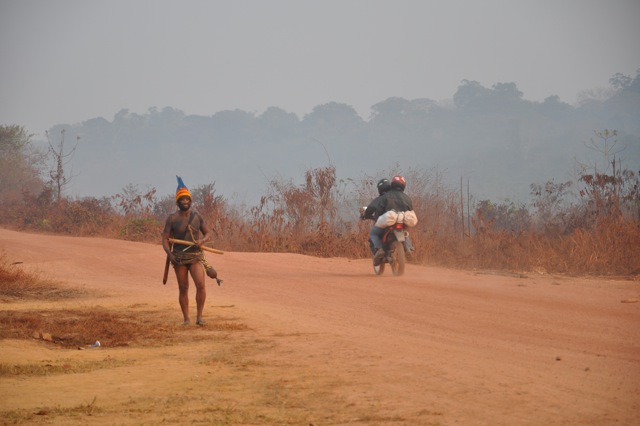
“It is hard to capture in a photo just how much smoke from forest fires is covering the area. It has been really bad for almost a week now. These pictures were taken on the outskirts of Cacoal, where Metareila, the association of the indigenous Surui people is located.

We are in the middle of the Amazon, where there just isn't enough industry and there are not enough cars to create smog like this over such a large area. The sky in these pictures should be full blue...there is not a cloud in the sky.”


Vasco van Roosmalen
ACT Brazil Director

Tuesday, August 17, 2010

Increasing Forest Fires in Rondonia, Brazil

For more than a week, a cover of smoke in the sky around the Brazilian state of Rondonia has drawn the attention of residents and visitors. Fires have increased significantly in the local forests. One of the hardest hit regions is between Porto Velho and Cacoal.

Smoke over Rondonia
The situation in Rondonia resembles that of other regions of the country. According to the National Institute of Space Research, fires in Brazil increased 85 percent in 2010. The research was based on the time period from January 1 through August 12. A recent article published by Folha de São Paulo, one of the most recognized newspapers in Brazil cited that 25,999 fires occurred during this period compared to 14,019 in 2009. Studies conducted by researchers from the Institute of Physics of São Paulo´s University (USP), and financed by Fapesp, found that the air quality in the Amazon during this period, due to fires, is worse than the air of São Paulo.

The states of Brazil with the largest number of fires were Mato Grosso (6,693); Tocantins (4,210); Pará (2,526); and Bahia (2,020). In 2010, Mato Grosso has experienced a 91percent increase in fires.

For over a decade, ACT has been pointing out the clear and unbreakable link between healthy forest and human health. In the southwest Amazon, the destruction of the forest has brought drought, fires, airport closures, economic costs and human misery.

Frederico Schlottfeldt
ACT Brazil
Communications Coordinator

Friday, August 13, 2010

Environmental Education

Editor's Note: Dr. Sara Bennett is a biologist who leads a small NGO, Maikuchiga, in Colombia’s Amacayacu National Park that operates a rescue center for orphaned animals.  The Park, in the nation’s Amazonas state, is traversed by the Amazon River. This post is one in a series from Dr. Bennett. Post originally developed February 6, 2010.

Saturday morning, Animals House. Claudia, the littlest, special-needs woolly monkey, is a nice warm, fast asleep, softly snoring, getting better lump on my lap. It’s raining quietly outside, with no drama.  The river’s rising.
Dr. Sara Bennett with manatee
There is no crisis at the moment and no one’s being bad (Aladino having just fixed the hole one of the squirrel monkeys either made or found to get into the kitchen and make a big mess).  A faraway hoodoo pigeon is calling “hoo doo, hoo doo.”  Lo, the spirit moves.
A friend from Palmeras, the community just upriver, told us last week that there was a woolly monkey in Eugenio’s house that was probably the aforementioned Surba. Jhon and I went up to check it out. It checked out and we’re concerned again.  They’d come across her in the woods about a two hour walk away, and either she came back with them or they brought her back and was with them a few days in their house. They left the house alone on Sunday and she was gone when they came back. The upriver communities think woolly monkeys are delicious and fair game. The four downriver communities think woolly monkeys are delicious and have agreed not to hunt them. We have spread the word that if someone helps us round her up (alive), the reward will be better than one monkey stew.
So, ahem, Topic for the Day here: environmental education in acculturated indigenous communities.  Whatever does this mean and how do you do whatever it is? Without being Right, culturally insensitive, overbearing, arrogant, well-meaning, out-of-context, irrelevant, disrespectful  …  There are a lot of reasons to let this be someone else’s responsibility.  Someone Else hasn’t shown up.

Tuesday, June 15, 2010

We Want our Planet Back.

New Orleans is the most aquatic of American cities.

This may seem surprising, in light of the fact that other cities exist atop islands, making them a more likely candidate for this title, but a number of factors bear consideration.

Sited as it is in a crescent-shaped bend in the Mississippi River, New Orleans is surrounded by river to the west, south, and east. And, to the north is Lake Ponchartrain, the second largest saltwater lake in the United States.

And what makes the city so thoroughly aquatic is the water underneath. When I was growing up in New Orleans, I was taught that we lived at sea level. Post-Katrina, we all know that such is not the case – the Crescent City, to a large degree, is below sea level. With the exception of some relatively high ground areas like the French Quarter, St. Charles Avenue and the Esplanade ridge, much of New Orleans is a below sea-level bowl into which water poured after that horrible hurricane.

Perhaps the two most unique aspects of New Orleans’ culture and history are intimately linked to this aquatic setting. Ask anyone who has been to New Orleans what makes the city so unique, and the two most common answers are almost always the same— food and music. And the food comes from the water around us: crabs, crawfish, oysters, shrimp, seafood gumbo and jambalaya, frogs legs and turtle soup. New Orleanians have a sensual – almost erotic - fixation with their food. Just ask an ex-pat New Orleanian planning on a visit to his or her hometown where and what they will be eating, and you will receive a detailed response more akin to planning the D-Day invasion of Normandy than a simple trip home.

And New Orleanians treasure most highly the foods from the waters that surround them. New Orleanians feast on foods from the waters.

From the classical compositions of Louis Gottschalk to the rhythm and blues piano of Professor Longhair to the rap stylings of Lil’ Wayne, New Orleans has produced more than its share of music and musicians. But the most important musical genre born in the Crescent City is jazz. While many different cultures contributed to the birth of jazz, most credit the combination of African, Caribbean, and European sounds as having the greatest influence. And all of these influences met and mixed because New Orleans was such an important port of entry into the United States.

But the Gulf through which New Orleans has derived so much sustenance – both edible and cultural – still fills with poison. In the wonderful 1999 film “Three Kings,” the American soldier played by Mark Wahlberg is captured by Saddam’s soldiers. They tie him up, say he and the Americans can have all the oil they want, and they force him to drink it – a sad, frightening, and somewhat appropriate analogy to the situation we have witnessed on the nightly news for 57 days.

Breaking our addiction to foreign oil has been a much bandied-about goal since the Carter Presidency. After 9/11, journalist Tom Friedman called for a dollar a gallon tax on gasoline to reduce demand and provide generous funding for research on alternative energy sources. None of these propitious cries were heeded.

BP’s CEO recently whined that he “wants his life back.” Well, Tony – we want our Gulf back.  We want our economy, culture, seafood, and our wetlands back.  We want our history and our way of life back. We want our planet back.

We are all somewhat complicit in this disaster—all of us who use fossil fuels, all of us who waste fossil fuels. But now we all see more of the real costs: injured wildlife, human suffering, and cultural degradation that happens when we do not treasure Mother Nature and her gifts.  Giving giant companies a free hand—free from regulation, free from oversight—does not mean there is a free ride.  Eventually, the bill comes due—and we all end up paying it.

Mark J. Plotkin, Ph.D.

Wednesday, March 3, 2010

ACT's Present Position on Climate Change

ACT believes, on the basis of very strong evidence, that accelerating global climate change is a reality, and that this acceleration is caused by human activities, specifically the injection of greenhouse gases into the atmosphere.

Though it is not possible to predict the exact consequences of the overall warming trend that this increase in the greenhouse effect creates, ACT also believes that it is sensible to expect that some local changes may have very negative effects on vulnerable populations, both human and otherwise.

Indeed, it is already obvious that many areas—notably the temperate zones where humans live—are becoming drier, putting increased pressure on already scant water resources. Over time, the more our planet warms, the fewer winners and the more losers there will be. Therefore, both mitigation and adaptation strategies are needed.


Read more about ACT and mitigating climate change.

Thursday, January 14, 2010

Tragedy in Haiti

Stories of despair are resonating around the world – stories of orphaned children, displaced families, and an absence of food and water. These stories simply cannot and should not be ignored. Recovery from natural disaster cannot easily be accomplished, yet the Haitian people continue to maintain resilience and look forward. We’re confident that they will prevail, as the Haitian people have for so many years proven that their collective heart is strong. In recent days, we’ve shown how powerful a movement for relief can be if we all pitch in for a common cause, and ACT shares its thoughts and prayers with those lost and hurt by the tragedy in Haiti. 

Find out how you can help by clicking here: http://www.cidi.org/incident/haiti-10a/


Mac Fanieh tries to rescue a teacher, trapped amid the rubble of the earthquake, as he crawls past a schoolgirl that died at Ecole St. Gerard Technical School in Port-au-Prince.

Carol Guzy-The Washington Post